Wednesday, April 13, 2011

Scrapbook Item 10: Gender and Sport: How Equitable are Opportunites for Women in Sport

Here is a link to the related article on the topic: http://www.wnba.com/news/2011_draft_espn.html.

The topic of equitable treatment in women's sports was discussed in class on April 12, 2011, and also in the book on pages 232-240.  This article states that the WNBA will have their draft televised once again for the 2011 season, and it will be from the campus of ESPN.  The problem is that the draft will be on at 3 pm on a Monday afternoon.  This gives no one a chance to watch the draft since most people are either at work or school at this time.  If this were to happen with the NBA draft, there would be sever backlash from millions, but since it is the WNBA no one puts up a fight.  Equality has to exist in all aspects of sport, not just on the playing field, and if ESPN is willing to have the draft on site why can't they have it in prime time.  The existence alone of this league over the last 15 years shows the progress women's sports has made.  As a country we have come a long way since the times we talked about in class when women could not even compete, or no one thought they were equal to men, but there still is a long way to go.

The WNBA and other women's professional and amateur leagues may not even be in existence today if it were not for government legislation.  In Coakley's text on page 232, he says that the new opportunities for women's sports have been fueled by this legislation, and without it women's sports still may not exist.  Coakley lists other reasons on page 233, citing the health and fitness movement, women's rights movement, and also increased media coverage as factors of increased participation.  The participation may have increased, but women's sports still do not receive equitable treatment.  The WNBA draft as mentioned before is not in prime time, while the NFL draft will take up three days of evening programming.   Also the best WNBA players barely make 100,000 a year, while average NBA players are making five million dollars.  The salaries have to do with the popularity of the sport, but the media needs to do a better job with women's sports leagues.  It all starts with the media.  Women's teams and leagues will never by popular if the games are never on for us to see.



Recent WNBA top draft pick Maya Moore.

Tuesday, April 12, 2011

Scrapbook Item 9: Traditional Race Logic Used in Sports

Here is a link to an article related to the topic: http://www.huffingtonpost.com/casey-ganemccalla/athletic-blacks-vs-smart_b_187386.html.

We discussed the topic of race logic in class on April 7, 2011, and this topic is covered by Coakley in the text on pages 282- 292.  In the article above, the author talks about how race logic is present in sports, but more importantly how these thoughts are being broken.  These ideologies included in the article are the same ones discussed in class, and they say that whites earn their athleticism through hard work and dedication, while blacks are naturally gifted athletes and are not concerned with education (This is also discussed on page 283 in the textbook).  When racial ideology is talked about most people talk about biology, and say blacks are wired better.  When this topic came up in class we said that there was no evidence proving this to be true, and the main reason blacks dominate in some sports has to do more with culture rather than biology.

In Coakley's text on page 286 the link between racial ideology and American culture.  He says that African Americans believe that the only way to become successful is through sport, since opportunities outside of sports are slim.  Many blacks believe it is their destiny to be good at certain sports,  and they are highly motivated to do so. When this topic was discussed in class it was said that blacks concentrate in the revenue producing sports, and in sports where there is not a high need of equipment.  Both of these reasons would lead them to basketball and football.  Also these two sports are filled with black role models, where as sports like golf and tennis are not.  Lack of role models may also be a way to explain the lack of black NFL quarterbacks.  As stated in the article, there are only a handful of good African American quarterbacks, with only one Super Bowl winner ever.  This may also have to deal with culture where blacks are not looking up to Dan Marino and Joe Montana, but rather to non quarterbacks such as Emmitt Smith or Jerry Rice.  Race ideology will always seem to be present in the United States as it has worldwide for centuries. As a society we must realize that just since the color of your skin says that you should be good at one thing should not limit your opportunities, whether it is the business world, or in athletics.

Saturday, April 9, 2011

Scrapbook Item 8: Race and Ethnicity; Are They Important

Here is the link to the article dealing with this topic: http://content.usatoday.com/communities/thehuddle/post/2011/03/warren-moon-criticism-of-cam-newton-is-blatant-racism/1.

We discussed the issue of race and ethnicity in sport on April 5, 2011, and this topic is covered in Coakley's text on pages 278-284.  This article is an example of the role of racism, discrimination, and stereotypes in sport and that they still exist today.  Cam Newton is being compared to other black quarterbacks who have failed in the past due to lack of work ethic, and being all about themselves.  The other white quarterbacks in the draft are not receiving the same criticism even though fellow draft prospect Ryan Mallet has tested positive for cocaine, but his character is hardly questioned. 

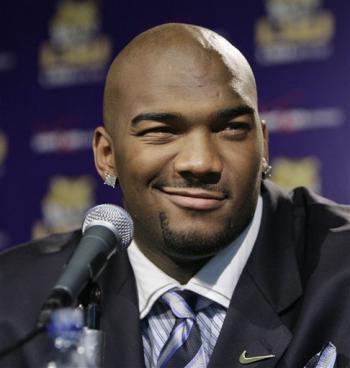
Jemarcus Russell, former quarterback
who Newton is being compard to.
This way of thinking is a result of stereotyping an individual on his or her race or ethnicity.  As we discussed in class a stereotype is a fixed idea about a group.  The reporter who wrote this article has a fixed idea that all black quarterbacks are lazy, fake, and can not be a leader.  This same reporter came down hard on Tim Tebow last year, but he did so on his football ability and not his character.  This individual is stereotyping Cam Newton since he looks like former failure Jemarcus Russell, and other black quarterbacks who have failed. 

This idea is also mentioned in Coakley's text on page 281 in which he discusses racial stereotyping.  He says that people judge all individuals into from one group the same way (which the reporter from this article has done).  He goes on to say on page 282 that these stereotypes are used by people who do not have an opportunity to get to know someone, so they just go ahead and generalize them based on race.

Saturday, April 2, 2011

Scrapbook Item 7: Deviance in Sports

Here is the link to the article dealing with this topic:  http://mlb.mlb.com/news/article.jsp?ymd=20110408&content_id=17514236&vkey=news_mlb&c_id=mlb.


The topic of  deviance in sport is discussed on pages 175-184 in Coakley's text, and was discussed in class on March 29, 2011.  During class on this day we talked about deviant behavior in sports, including the use of performance enhancing substances, and the different leagues drug testing policies.  Manny Ramirez who is featured in this article is a great example of an athlete showing deviant behavior in sports.  His actions on the field were continuously out of line during his career, as he would go to the bathroom during games, and not act professional. Now he has tested positive for a banned substance for the second time, and would have received a 100 game suspension if he did not choose to retire.  By threatening to suspend star player Manny Ramirez before he chose to retire, this shows that Major League Baseball is once again serious about their drug policy after their policy was a joke up until recently.
 
In class on March 29 we learned that the definition of performance enhancing drugs was; any substance taken that is not prescribed by a doctor, and does specify the purpose of improving performance by increasing strength, power, speed, and endurance.  With the announcement of Ramirez’s positive test, not many fans were surprised at all since drugs have become rather common in the sports we watch today.  In Coakley's Text on page 180 he says that the reasons athletes do in fact dope is to maintain their level of greatness, prolong a career, meet others expectations, and to receive financial rewards.  All of these factors contribute to Ramirez’s drug use.  He was an aging Hall of Fame player who was making millions of dollars a year.  So if he could take a substance and remain playing at a high level, why wouldn't he?

As noted above Ramerez conducted himself in a deviant way while on the field as well.  In Coakley’s text on page 177 Coakley suggests that players may do this on purpose to create a ‘commercial persona”.  He says that athletes use their bad behavior as a way to gain fame, and endorsements, which Ramirez did throughout his career.  He used his bad boy brand to receive endorsements and become one of the more popular players in the world.


Manny Ramirez comes out of the bathroom during the middle of a game at Fenway Park.  This is just one of Ramirez's many acts of deviance throughout his career.

Wednesday, March 30, 2011

Scrapbook Item 6: Sports and the Economy

New Home of the New York Mets with an estimated cost of 900 million dollars


Here is a link to the article talking about whether or not new stadiums are worth it: http://www.american.com/archive/2008/april-04-08/a-closer-look-at-stadium-subsidies.

This topic was discussed in class on March 17, 2011, and also in Coakley's text on pages 375 through 379.  In this article the author goes into detail about the reasoning of why public funding is used for new stadiums, and how much.  Also he discusses if the stadiums actually help the surrounding areas economy enough to warrant public assistance, and the author actually suggests that new facilities hurt the local economy.

In Coakley's text on page 375 he states that public assistance for team owners to build new stadiums is "welfare for the rich", and the owners use this money for personal gain.  Also on pages 376 and 377 Coakley goes into detail about the lack of economic growth in areas with new stadiums.  If the cities are seeing no benefit from the stadium, then why should they be built?  As Coaley's text says on page 377, Cleveland built three new stadiums in the 1990's as there school system, and inner city neighborhoods were losing funding.  The public money spent on stadiums could be used elsewhere in major cities where many people are living in poverty, but the owners are receiving tax exemptions on their billion dollar stadiums.  As discussed in class the new jobs that come from these stadiums are only seasonal, and the construction companies used to build them come from out of town, which seem to be the leading reasons owners use to build new stadiums.  With so much money coming from the public they should see some benefit in the local area, but as of now the only thing the public is seeing is lack of funding for more important areas,and higher ticket prices.


The new Yankee Stadium in New York cost over 1 billion dollars to build.

Sunday, March 27, 2011

Scrapbook Item 5: Can Sports Exist Without the Media?

Here is a link to the related article: http://www.theroar.com.au/2010/01/20/media-dictates-the-popularity-of-sports-in-australia/

The link between sports and the media is outlined in Coakley's text on pages 404-408, the same topic was discussed during class on March 21, 2011.  This article is a good example of how the media controls sports, and specifically which sports its viewing audience is interested in.  As stated in class, the media controls sports popularity by providing coverage of certain sports, and they dictate these sporting events by paying millions for the rights to broadcast them.  In the article the author writes that in Australia controls which sports are popular at specific times during the year, especially with the Australian Open in January.  He says without the media not as many people would care about tennis, but the Open provides a story for the media to cover.  This proves that the media says a say in the popularity of sports, without the media would as many people be interested in the Australian Open, or would they rather watch rugby, or soccer?

According to Coakley's text on page 404 he writes that the media does control the commercialized sports with media coverage and television rights revenues.  Coakley says that the sports organizations depend on these revenues and media coverage to draw attention to the sport, and without the media sports would not be as profitable.  In television rights alone in 2008 the NFL received 3.7 billion dollars compared to the 400 million in 1986.  The media provides the leagues with huge revenues just to cover their events.  As said in class the teams have changed schedules and times to fit the time slots of companies, and also added TV timeouts, and expanded leagues.  In the article the media has made tennis important, as the fan base continues to decline.  The sport fan has no choice but to watch the event if that is what the media is going to cover.  Who knows without the media would the Australian Open still exist?


Exclusive sports channels such as this one are growing worldwide, and will be the future of sports viewing.

Monday, March 14, 2011

Scrapbook Item 4: Do Varsity Sports Contribute to Education?


.
The following is a link to the article: http://www.stanforddaily.com/2011/03/09/1046687/

The topic of education and athletics is discussed in Coakley's text on pages 481-490 and the same topic was covered during class throughout the first part of the semester.  This article illustrates a perfect example of athletes getting special treatment that general students do not receive.  As discussed in class this list of easier classes gives athletes easy grades and majors to help them stay eligible.  One professor in the article says that she thinks the list is needed to help athletes meet the high demands they have on the field.  This shows that even a school as prestigious as Stanford fails to put athletics first. 

As stated in Coakley's text on page 483 athletes are pressured by the team culture to focus more on their sport than academics so they can meet their coaches expectations.  Also, no one expects the athletes to be good students, and the only thing expected of them is to excel in his or her particular sport.  As discussed in class the pressure to win and to make money puts the focus more on athletic performance and not academics.  In Coakley's text on page 483 he states that athletes are not praised for doing good academically, but only for their on field performance.  In page 487 in the text Coakley also says that athletes spend more time engaging in their sport than in the classroom.  This article is disappointing especially coming from an institution who values education as much as Stanford.  For years the school has struggled competing in sports due to their academic requirements.  However with the latest news it looks like Stanford has caved in just like too many other schools.  It looks like the temptation of millions is too much for any school to ignore, even if that means sacrificing the academic excellence the school once had. 


The following is a link to a video related to the above topic: http://abclocal.go.com/kgo/video?id=8004606.