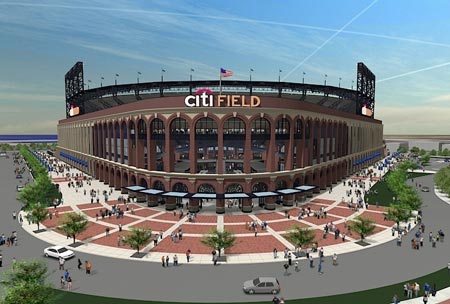
New Home of the New York Mets with an estimated cost of 900 million dollars
 |
Here is a link to the article talking about whether or not new stadiums are worth it: http://www.american.com/archive/2008/april-04-08/a-closer-look-at-stadium-subsidies.
This topic was discussed in class on March 17, 2011, and also in Coakley's text on pages 375 through 379. In this article the author goes into detail about the reasoning of why public funding is used for new stadiums, and how much. Also he discusses if the stadiums actually help the surrounding areas economy enough to warrant public assistance, and the author actually suggests that new facilities hurt the local economy.
 In Coakley's text on page 375 he states that public assistance for team owners to build new stadiums is "welfare for the rich", and the owners use this money for personal gain. Also on pages 376 and 377 Coakley goes into detail about the lack of economic growth in areas with new stadiums. If the cities are seeing no benefit from the stadium, then why should they be built? As Coaley's text says on page 377, Cleveland built three new stadiums in the 1990's as there school system, and inner city neighborhoods were losing funding. The public money spent on stadiums could be used elsewhere in major cities where many people are living in poverty, but the owners are receiving tax exemptions on their billion dollar stadiums. As discussed in class the new jobs that come from these stadiums are only seasonal, and the construction companies used to build them come from out of town, which seem to be the leading reasons owners use to build new stadiums. With so much money coming from the public they should see some benefit in the local area, but as of now the only thing the public is seeing is lack of funding for more important areas,and higher ticket prices.
The new Yankee Stadium in New York cost over 1 billion dollars to build.


